
Showing posts with label educational technology. Show all posts
Showing posts with label educational technology. Show all posts
Saturday, June 21, 2014


Sunday, August 11, 2013
A Sure Sign of a Teacher-Centered Classroom
Last week I heard a teacher (not from my school!) say, "I just got my new SmartBoard! I love it so much that my kids will have to fight me to ever get to use it." She wasn't kidding.
And therein lies one of the pitfalls of interactive whiteboards (or any technology) in the hands of a teacher who fails to understand the importance of a student-centered classroom.
Need I say more?
And therein lies one of the pitfalls of interactive whiteboards (or any technology) in the hands of a teacher who fails to understand the importance of a student-centered classroom.
Need I say more?
Saturday, July 27, 2013
Amidst Technology Buzz, Don't Forsake Reading, Writing and Discussion
The Twitter feeds, RSS feeds, blogs and news outlets include more information today about educational technology than ever before. As funding for edtech increases, teachers will be enjoying access to more edtech in the coming years than they've ever had access to before, even in poorer districts and schools. Indeed, teachers all over the world now have at their disposal more hardware, apps, social media and other edtech options than at any time in history, and they have a plethora of IT help (both flesh and blood and digital) to get technology integrated successfully and meaningfully into their classrooms. The move toward integration of technology into classrooms has been building momentum for a number of years and classroom teachers will be reaping the benefits of that momentum more than ever beginning with the 2013-14 school year. This is a good thing... up to the point that it isn't.
As educational leaders, we must be good stewards of the finite number of classroom minutes allotted to us each year. One of the items on our ever-growing and ever-changing job descriptions must be balancing the integration of technology with the practice of invaluable educational staples like reading, writing and discussion. The edtech movement perhaps has blinded some educators and has given other educators amnesia. In other words, there exist many edtech advocates who gladly would sacrifice reading, writing and discussion for more technology. Do not be one of those. Room must be made for both.
Without a doubt, students today benefit from creative and meaningful integration of electronic texts, social media, laptops, iPads, smartphones, apps, the cloud, etc., into their classroom experience. No matter how great the integration of technology for those students, though, an insufficient amount of reading (sustained reading of a variety of texts across the disciplines), writing (more than just 140 characters) and discussion (not just in chat rooms or on discussion boards, but engaging oral and written conversations) will leave those students unprepared for success in the 21st century. Likewise, a steady diet of reading, writing and discussion alone will leave students equally unprepared.
As an educational leader, do not allow your district, school, peers, teachers, or anyone else to throw the proverbial baby out with the bathwater. Edtech without reading, writing and discussion does students harm in the same way reading, writing and discussion with no edtech does students harm. When done correctly, edtech certainly can support, enhance and add value to reading, writing and discussion. Edtech alone, though, provides a poor substitute for a meaningful classroom experience.
As educational leaders, we must be good stewards of the finite number of classroom minutes allotted to us each year. One of the items on our ever-growing and ever-changing job descriptions must be balancing the integration of technology with the practice of invaluable educational staples like reading, writing and discussion. The edtech movement perhaps has blinded some educators and has given other educators amnesia. In other words, there exist many edtech advocates who gladly would sacrifice reading, writing and discussion for more technology. Do not be one of those. Room must be made for both.
Without a doubt, students today benefit from creative and meaningful integration of electronic texts, social media, laptops, iPads, smartphones, apps, the cloud, etc., into their classroom experience. No matter how great the integration of technology for those students, though, an insufficient amount of reading (sustained reading of a variety of texts across the disciplines), writing (more than just 140 characters) and discussion (not just in chat rooms or on discussion boards, but engaging oral and written conversations) will leave those students unprepared for success in the 21st century. Likewise, a steady diet of reading, writing and discussion alone will leave students equally unprepared.
As an educational leader, do not allow your district, school, peers, teachers, or anyone else to throw the proverbial baby out with the bathwater. Edtech without reading, writing and discussion does students harm in the same way reading, writing and discussion with no edtech does students harm. When done correctly, edtech certainly can support, enhance and add value to reading, writing and discussion. Edtech alone, though, provides a poor substitute for a meaningful classroom experience.
Sunday, March 31, 2013
Who are the BulahBots?
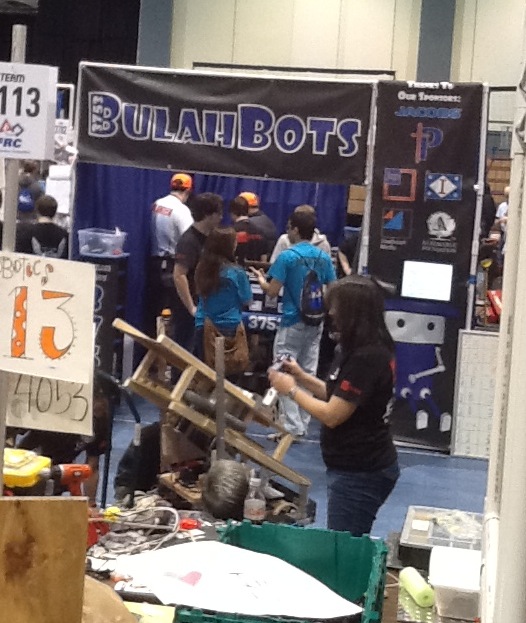
Almost two years ago, I blogged about a book called The New Cool, which tells the inspiring (on a number of levels) story of a FIRST Robotics team and their journey. Recently I have been following another FIRST Robotics team with particular interest, FIRST Team 3753 - BulahBots. Led by Shawn Liner, this team from Parkview Baptist School in Baton Rouge recently landed themselves on the FIRST map by earning a trip to the FIRST Robotics Championship (as in National Championship) in St. Louis. I figured this would be the perfect time to share their story with you and provide you with some food for thought over the next few weeks. Before we get into all the takeaways from such a program, let's get to know FIRST Team 3753 a little better. Shawn graciously agreed to indulge my barrage of questions, and the first part of my interview with him appears below. I will post updates and additional portions of the interview periodically so check back frequently.
You can follow FIRST Team 3753 on their website or on their Facebook page.
Now, I give you the BulahBots...
 Nathan: What is FIRST Robotics?
Shawn: Touted as the “Varsity Sport For The Mind”, FIRST Robotics is an organization that uses robots to create an athletic atmosphere for a mental competition. FIRST actually runs from young middle school through high school. For younger students there are Lego-based robotics competitions, where the robot is small enough to fit on a table. For high school students, the robots can weigh in at 135 pounds and stand 6 feet tall. Teams are encouraged to simulate an engineering firm with different components, such as image teams, public relations, community outreach, project management, budget control, and of course product (the robot).
Nathan: What inspired you to create a FIRST Robotics team at your school?
Shawn: I teach at a private school where many of my students have not really had a “shop” experience. However, I’m teaching tomorrow’s physicists, chemists, doctors and engineers. I often have used tools as an example in class and students wouldn't really have a grasp of those tools. I also felt that students were going into the engineering field (or choosing not to) out of an ignorance of engineering actually is and what engineers actually do. As a result I created an introduction to engineering class that is intended to be a survey course of engineering. We talk about what each discipline does, we do some drafting, we do some programming, we build some Lego robots, and we launch some water rockets, all the while learning how they work. I've thought of doing all of these things in physics class, but I run out of time before I get to really experiment with some of these different activities. This course became my sandbox where I could play a little without compromising the curriculum of an AP Physics class.Then, at an NSTA conference, I took a field trip to see FIRST robotics. I saw kids doing so many of the things that I was trying to get across to them in engineering class. However, they were showing up after school to do it and then they were in the stands cheering each other on for it. So I had to dig further. The problem is that robotics is expensive. Therefore, it took me a while to get the program up and running.
Nathan: How did you recruit kids to participate? Was there a "sales pitch?"
Shawn: I handpicked ten kids and recruited them. “Hey, come watch this video, you want to do this?” Six of them bit and we started a team. The next fall we had a “club fair” at school where we got to show off our club and our robot. We drove the robot around and I had twice that many kids interested in no time at all. Now I've got twenty kids and don’t really know what to do with them all. After presenting our regional trophy to the school at chapel, I've already had several new inquiries this semester.
 Nathan: How did you come up with Bulah Bots?
Shawn: I was determined to have a school team. I wanted to see students pour the kind of energy usually reserved for football and basketball into engineering. So I dug around for something related to our mascot. Unfortunately, “eagles” is a very common mascot and we wanted to compete nation-wide. Names like eaglebots, eagle robotics, etc, were all taken. We tried Raptor Robotics. It was nice, but didn't have the ring to it that we wanted. My image team sat and brainstormed ideas. I told them to ignore the school connection at first and just think of stuff. "Think like an engineering/athletic company that wanted a marketable, copyrightable, name, image logo etc." After the initial brainstorm they presented ideas. They had some good ideas, but I was bothered by straying away from our school completely. (By the way, most school team names, colors, mascots, etc, have little or nothing to do with their school). I asked for another brainstorm session and they hit on BulahBots. “Bulah” is a chant/drum cadence that our school borrowed from Yale. So we had something there, and no graduate of our school asks us where the name comes from. It’s like an inside story that automatically endears us to our alumni. We’ve chosen an official spelling and font, created a website, chosen official team colors, and created “Bulah” our mascot, a little robot in 3D program that we can pose for iconic recognition on t-shirts, buttons, etc.
Nathan: What does your team's robot do?
Shawn: The game changes every year. This year our robot receives Frisbees on one end of the field, drives (fast) to the other end of the field and shoots them into a goal that is roughly nine feet off the ground. We are also equipped to hang from a horizontal pole that is thirty inches off the ground; this is a bonus round of the game. We had to make many tough choices in designing our bot, giving up on some things in order to do what we do well.
 Nathan: How did your team come up with the design to accomplish that task?
Shawn: Mostly brainstorm and mockup. We spent several hours trading the marker in front of my classroom's dry erase board. We used lumber to mock up our ideas and made sure they worked before we built the final part. An intern from LSU also was able to CAD up some of our ideas so that we were sure things would fit. After that, it was tweaking and more tweaking.
Nathan: Did it work the first time your team attempted the task?
Shawn: Well, yes, mostly. We did mock them up and CAD them up before we really built. It shot inconsistently at first and we found it was better to allow the wheel to compress instead of the Frisbee. We did spend over a week (I’d guess twenty to thirty hours) practicing the driving, loading, and climbing before competition. As part of the process we also chose our drivers, and feeders during that time.
Intrigued yet? Stay tuned for more about the Bulah Bots and what this experience teaches kids beyond just how to build a robot and toss Frisbees.
You can follow FIRST Team 3753 on their website or on their Facebook page.
Now, I give you the BulahBots...

Shawn: Touted as the “Varsity Sport For The Mind”, FIRST Robotics is an organization that uses robots to create an athletic atmosphere for a mental competition. FIRST actually runs from young middle school through high school. For younger students there are Lego-based robotics competitions, where the robot is small enough to fit on a table. For high school students, the robots can weigh in at 135 pounds and stand 6 feet tall. Teams are encouraged to simulate an engineering firm with different components, such as image teams, public relations, community outreach, project management, budget control, and of course product (the robot).
Nathan: What inspired you to create a FIRST Robotics team at your school?
Shawn: I teach at a private school where many of my students have not really had a “shop” experience. However, I’m teaching tomorrow’s physicists, chemists, doctors and engineers. I often have used tools as an example in class and students wouldn't really have a grasp of those tools. I also felt that students were going into the engineering field (or choosing not to) out of an ignorance of engineering actually is and what engineers actually do. As a result I created an introduction to engineering class that is intended to be a survey course of engineering. We talk about what each discipline does, we do some drafting, we do some programming, we build some Lego robots, and we launch some water rockets, all the while learning how they work. I've thought of doing all of these things in physics class, but I run out of time before I get to really experiment with some of these different activities. This course became my sandbox where I could play a little without compromising the curriculum of an AP Physics class.Then, at an NSTA conference, I took a field trip to see FIRST robotics. I saw kids doing so many of the things that I was trying to get across to them in engineering class. However, they were showing up after school to do it and then they were in the stands cheering each other on for it. So I had to dig further. The problem is that robotics is expensive. Therefore, it took me a while to get the program up and running.
Nathan: How did you recruit kids to participate? Was there a "sales pitch?"
Shawn: I handpicked ten kids and recruited them. “Hey, come watch this video, you want to do this?” Six of them bit and we started a team. The next fall we had a “club fair” at school where we got to show off our club and our robot. We drove the robot around and I had twice that many kids interested in no time at all. Now I've got twenty kids and don’t really know what to do with them all. After presenting our regional trophy to the school at chapel, I've already had several new inquiries this semester.
 Nathan: How did you come up with Bulah Bots?
Shawn: I was determined to have a school team. I wanted to see students pour the kind of energy usually reserved for football and basketball into engineering. So I dug around for something related to our mascot. Unfortunately, “eagles” is a very common mascot and we wanted to compete nation-wide. Names like eaglebots, eagle robotics, etc, were all taken. We tried Raptor Robotics. It was nice, but didn't have the ring to it that we wanted. My image team sat and brainstormed ideas. I told them to ignore the school connection at first and just think of stuff. "Think like an engineering/athletic company that wanted a marketable, copyrightable, name, image logo etc." After the initial brainstorm they presented ideas. They had some good ideas, but I was bothered by straying away from our school completely. (By the way, most school team names, colors, mascots, etc, have little or nothing to do with their school). I asked for another brainstorm session and they hit on BulahBots. “Bulah” is a chant/drum cadence that our school borrowed from Yale. So we had something there, and no graduate of our school asks us where the name comes from. It’s like an inside story that automatically endears us to our alumni. We’ve chosen an official spelling and font, created a website, chosen official team colors, and created “Bulah” our mascot, a little robot in 3D program that we can pose for iconic recognition on t-shirts, buttons, etc.
Nathan: What does your team's robot do?
Shawn: The game changes every year. This year our robot receives Frisbees on one end of the field, drives (fast) to the other end of the field and shoots them into a goal that is roughly nine feet off the ground. We are also equipped to hang from a horizontal pole that is thirty inches off the ground; this is a bonus round of the game. We had to make many tough choices in designing our bot, giving up on some things in order to do what we do well.
 Nathan: How did your team come up with the design to accomplish that task?
Shawn: Mostly brainstorm and mockup. We spent several hours trading the marker in front of my classroom's dry erase board. We used lumber to mock up our ideas and made sure they worked before we built the final part. An intern from LSU also was able to CAD up some of our ideas so that we were sure things would fit. After that, it was tweaking and more tweaking.
Nathan: Did it work the first time your team attempted the task?
Shawn: Well, yes, mostly. We did mock them up and CAD them up before we really built. It shot inconsistently at first and we found it was better to allow the wheel to compress instead of the Frisbee. We did spend over a week (I’d guess twenty to thirty hours) practicing the driving, loading, and climbing before competition. As part of the process we also chose our drivers, and feeders during that time.
Intrigued yet? Stay tuned for more about the Bulah Bots and what this experience teaches kids beyond just how to build a robot and toss Frisbees.
Friday, November 23, 2012
Looking for Educators on Twitter?

- Annette Breaux - http://twitter.com/AnnetteBreaux
- Todd Whitaker - http://twitter.com/ToddWhitaker
- Khan Academy - http://twitter.com/khanacademy
- Karl Fisch - http://twitter.com/karlfisch
- Michelle Rhee - http://twitter.com/m_rhee
- Barbara R. Blackburn - http://twitter.com/BarbBlackburn
- Dave Levin - http://twitter.com/Dave_KIPP
- Michael Feinberg - http://twitter.com/kippbigdog
- Robert Marzano - http://twitter.com/robertjmarzano
- Daniel Pink - http://twitter.com/DanielPink
- Sir Ken Robinson - http://twitter.com/SirKenRobinson
Sunday, August 12, 2012
If You Want to Flip Your Classroom...

These two chemistry teachers from Colorado have put together a step-by-step handbook for how to transition from a traditional, direct-instruction classroom to one in which the teacher has time to talk to every kid, in every class, every day (their words, not mine - what a great concept). Rather than preaching to the reader about why every classroom should be flipped, Bergmann and Sams explain how they've made this model successful over the last several years. They even point out mistakes they've made so the reader can avoid the same pitfalls.
I'm not going to weigh in on whether flipping your classroom should be on your to-do list or not. Instead, I'm going to recommend that you read this book before you try it. Be sure to check out the Flipped Learning Network, too. Even if you have little or no interest in flipping your classroom, much of what they discuss simply falls into the categories of "just good teaching" and "what's best for kids." I think back to my dreadful experience with chemistry in high school... Where were Mr. Bergmann and Mr. Sams when I needed them?
Tuesday, March 13, 2012
Khan Academy Announces App for the iPad

Khan Academy, a treasure trove of educational video tutorials, recently released an app for the iPad. Now you can have access to more than 2700 videos not only from your computer but also your iPad. If you are not familiar with Khan Academy, you must check it out. If you already know about Khan Academy, you must get this app. As if Sal Khan and his team had not yet established Khan Academy as a legitimate force in 21st-century education, they certainly have done so now.
Saturday, August 13, 2011
A 21st-Century Twist on Current Events Classroom Activities
Remember the days of "Current Event Fridays" in Coach Whatshisname's class? You remember, every Thursday night or Friday morning before school, you stole your father's newspaper (yes, real paper newspaper) to clip an article to paste into a folder and turn in for a completion grade. Hopefully those days are gone for good in your school. If you're still observing something similar in your classrooms, it's time for an update.
Imagine a social studies class in a computer lab or in a class in which everyone has a laptop, an iPad or a smartphone with access to the Internet. Now imagine that after a week of teaching and learning about a particular topic, the student's walk in to discover "Current Event Day" written on the board. The teacher instructs the students to go to Google, then to click the News link at the top left. The teacher the says, "Today's current event topic is Arab Spring. Go!" Immediately the students enter the phrase, hit return and start claiming articles: "I've got the Guardian article" and "I've got one from the New York Times" and "Here's one from the Pakistan Daily Times" and "Cool! Here's one from The Onion!" and yet another says "How about one from Al Jazeera?" Ten minutes later, the teacher leads the class in a deep, meaningful discussion of the Current Event Day topic but with input based on global and widely varied perspectives.
Now imagine this same scenario happening in math class, or science class, or lit class, or...
The benefits should be obvious: the current event info actually can be current now; kids are plugged in and engaged; the activity lends itself to reading-writing-discussion or problem-solving (depending on how the teacher customizes the activity); the activity can be used in any class at virtually any level K-12; kids don't need to rustle up someone's newspapers; kids can have a truly global experience quickly and easily.
This is an easy way to keep an age-old favorite activity of teachers at all levels without staying stuck in a rut. Give this a try in the first few weeks of school and I promise you and your teachers will never go back to the old current events assignments again.
Sunday, May 15, 2011
The New Cool - A Must Read for Science Teachers This Summer
 Let me jump straight to the point: this is the best educational book I've read in a long time. Interesting, then, that this book is not even an educational book. The New Cool: A Visionary Teacher, His FIRST Robotics Team, and The Ultimate Battle of Smarts, by Neal Bascomb, tells the story of the FIRST (For Inspiration and Recognition of Science and Technology) robotics team from Dos Pueblos Engineering Academy. The book chronicles the 2009 Dos Pueblos Engineering academy robotics team, Team 1717, and its leader, Amir Abo-Shaeer, as they work crazy hours, under sometimes crazy conditions and against all odds to compete in the annual FIRST Robotics Competition.
If you are a science teacher, you must read this book this summer. If you're an administrator, order this book today and make it available (if not mandatory) for your science teachers this summer. Why? The answer is simple. This book proves the lengths kids will go to in order to pursue something that sparks an interest for them. More importantly, this books validates the position that real learning takes place when kids are allowed (encouraged, compelled) to be creative, collaborative problem-solvers.
Not every science class can tackle a monstrous project like the FIRST Robotics Competition but every science classroom can take a proverbial page or two from this book and transform what happens in the classroom. Let me restate: every science classroom, regardless of how many standards are imposed by the powers that be, can adopt some Amir Abo-Shaeer's approach to teaching science.
Congratulations to the Team 1717 D'Penguineers for the incredible run in 2009! Congrats on the book and the exposure for you and your alma mater!
In my next post, I will apply Jane McGonigal's thesis of Reality Is Broken to show you exactly why Team 1717, as featured in , worked as long and as hard as they did for a school activity.
Saturday, October 16, 2010
Using Hamlet's Blackberry to Help Our Digital Natives Disconnect
I just finished an interesting book by William Powers, Hamlet's Blackberry: A Practical Philosophy for Building a Good Life in the Digital Age. The premise of the book is that throughout history man has struggled with the best uses for new technology (written language, books, printing press and more) and 21st-century man is struggling once again in this digital age of perpetual connectedness and, as the author says, "busyness." Powers cites some interesting historical examples and makes compelling arguments. If you're as plugged in and connected as I, you might do well to read this one.


More importantly, as a result of this book, I really started contemplating what we're about to do at school. Next school year we're joining the growing number of schools that are one-to-one laptop schools. Don't get me wrong - I'm thrilled we're finally joining the 21st century and equipping our students and teachers with powerful educational tools. However, we're about to take our hyper-connected kids and make them "perpetually connected," as Powers says.
I've seen firsthand how this state of perpetual connectedness wears on me and other workaholics like me and I'm feeling a sense of responsibility to stop the madness before it begins with my students. Powers has a great chapter in the book in which he sums up seven other chapters. Chapter Twelve is "Not So Busy - Practical Philosophies for Every Day." He cites historical examples of Plato, Seneca, Gutenberg, Shakespeare, Ben Franklin, Thoreau and McLuhan, and offers some really insightful strategies for, as he says, "building a good life in the digital age." I've already begun thinking about how to adapt this chapter to create a presentation for my students next year on how to create disconnected, unplugged time for themselves. (As much as I'd love to share the details of the chapter in great detail, I'm sure Mr. Powers would rather you purchase the book.)
How can we issue laptops and other wireless devices to our kids without also equipping them to disconnect and experience some healthy, unplugged alone time?
Monday, October 11, 2010
Gates Announces Technology Grants for Higher Ed with K-12 Grants Coming Next Year
The Bill and Melinda Gates Foundation announced today a new initiative called the Next Generation Learning Challenges. The initiative, backed by $20 million from the Bill and Melinda Gates Foundation, is designed to promote the innovative development and use of technology at the college level, especially in the area of online learning. Grants to be awarded will range from $250,000 to $750,000 each. Some of the initial funds will be used to bolster online courses at the college level.
For those educators in K-12 education, take notice: though the grants for the Next Generation Learning Challenges will be awarded in 2010 to collegiate programs, funds will be available for K-12 proposals early in 2011. Put on your proverbial thinking cap and get your creative juices flowing. Here's your chance at some major funding for a unique, creative proposal involving educational technology with an emphasis on online learning and sharing. When full details are made available, I will post them here.
Happy thinking!
For those educators in K-12 education, take notice: though the grants for the Next Generation Learning Challenges will be awarded in 2010 to collegiate programs, funds will be available for K-12 proposals early in 2011. Put on your proverbial thinking cap and get your creative juices flowing. Here's your chance at some major funding for a unique, creative proposal involving educational technology with an emphasis on online learning and sharing. When full details are made available, I will post them here.
Happy thinking!
Monday, August 30, 2010
Skype in the Admissions Office: Opening Up A Whole New World
A few weeks ago we received an application for admission to our school from an outstanding candidate. This kid had everything we look for in a candidate. Just one small detail prevented us, however, from bringing her in right away to do the admissions interview and complete the admissions process: our school is in Houston and she was in South Africa!


We certainly did not want to invite a student to our school without an interview. Financially, it made no sense to have the candidate fly in from South Africa just for the interview. When we found ourselves in a conundrum, it was Skype to the rescue! We scheduled a time that worked in Houston and in South Africa and we did the admissions interview via Skype. We loved her. She loved us. Fast forward two weeks and she's happily enrolled in classes in Houston, Texas.
Saturday, August 28, 2010
More Thoughts on Digital Textbooks
Earlier in the week I posted a quick thought about whether digital textbooks might be a mistake for today's students. The idea came to me after reading The Shallows: What the Internet is Doing to Our Brains by Nicholas Carr. The data in the book that sparked this idea for me is that the Internet, as wonderful as it is, actually may be rewiring our brains. How? The Internet is full of links, videos and other distractions that cause or brains to lose focus. While reading pages from books, our brains become engrossed and engaged. While reading pages on the Internet, our brains fight against distractions constantly. For example, every time we read an article, a blog post, or some other text on the Internet with a hyperlink, our brains stop momentarily to decide whether or not to click on the link. It is not always a conscious decision, necessarily, but it is a decision and a distraction nonetheless. This stopping and restarting affects the brain's ability to absorb information. This effect has led to a change in the attention span and ability to concentrate in people who are plugged in constantly to the Internet. Their brains are being rewired.
If we take this research and apply it to textbooks, we may have a problem. Here is my line of thinking. I worry that a digital textbook with interactive elements, links, embedded videos and the like, may actually inhibit a student's ability to concentrate on the reading material and, therefore, inhibit a student's ability to commit the information in the text to memory.
My good friend and teacher-extraordinaire, Shawn, pointed out with a comment on the last post on this topic that a textbook for him would be more of a resource rather than a primary source of information (not primary source as in primary and secondary sources). This made me think even more. I totally see Shawn's point that a digital textbook used to support or reinforce concepts covered in class could be enhanced by all the digital bells and whistles and could then enhance a student's learning experience. I can see this happening especially in math and science, again if the digital textbook is used to support or reinforce concepts used in class. I can also see language courses benefiting from digital textbooks. In math, science and second languages, students rarely are required to read large chunks of the textbook and then commit the material to memory in one sitting.
Conversely, in courses like British Literature or AP European History, the assignments from the textbooks or novels often are read before the material is broken down and expanded upon in class. In these situations, I think a digital textbook (or novel) full of links and other interactive elements could be detrimental to a student's attempts to read for comprehension. Certainly media or interactive elements could be assigned to students later, even immediately following the reading, to enhance or illustrate the concepts from a reading assignment. Having irresistible links and other media embedded in the text, though, absolutely would lure students away from Beowulf or a chapter about the Agricultural Revolution.
There are huge advantages to digital textbooks in general. Some are totally customizable. Many are less expensive than traditional textbooks. Some are free. Digital textbooks certainly help reduce the amount of books students have to haul from place to place. I just think it would be wise to consider some of Carr's ideas before making the decision to replace all traditional textbooks with digital textbooks.
If we take this research and apply it to textbooks, we may have a problem. Here is my line of thinking. I worry that a digital textbook with interactive elements, links, embedded videos and the like, may actually inhibit a student's ability to concentrate on the reading material and, therefore, inhibit a student's ability to commit the information in the text to memory.
My good friend and teacher-extraordinaire, Shawn, pointed out with a comment on the last post on this topic that a textbook for him would be more of a resource rather than a primary source of information (not primary source as in primary and secondary sources). This made me think even more. I totally see Shawn's point that a digital textbook used to support or reinforce concepts covered in class could be enhanced by all the digital bells and whistles and could then enhance a student's learning experience. I can see this happening especially in math and science, again if the digital textbook is used to support or reinforce concepts used in class. I can also see language courses benefiting from digital textbooks. In math, science and second languages, students rarely are required to read large chunks of the textbook and then commit the material to memory in one sitting.
Conversely, in courses like British Literature or AP European History, the assignments from the textbooks or novels often are read before the material is broken down and expanded upon in class. In these situations, I think a digital textbook (or novel) full of links and other interactive elements could be detrimental to a student's attempts to read for comprehension. Certainly media or interactive elements could be assigned to students later, even immediately following the reading, to enhance or illustrate the concepts from a reading assignment. Having irresistible links and other media embedded in the text, though, absolutely would lure students away from Beowulf or a chapter about the Agricultural Revolution.
There are huge advantages to digital textbooks in general. Some are totally customizable. Many are less expensive than traditional textbooks. Some are free. Digital textbooks certainly help reduce the amount of books students have to haul from place to place. I just think it would be wise to consider some of Carr's ideas before making the decision to replace all traditional textbooks with digital textbooks.
Saturday, August 21, 2010
Could Digital Textbooks Be a Mistake?

 I just finished The Shallows: What the Internet is Doing to Our Brains by Nicholas Carr and I feel compelled to get some thoughts organized while its ideas are still fresh on my mind. While The Shallows is an interesting book on its own, it is especially thought-provoking when considered along with Born Digital. The premise of the latter book is that kids today, who are digital natives because they were born into an entirely digital world, possess brains that are physically hard-wired differently from kids' brains of generations past because of the way they interact with all things digital. The Shallows, coincidentally, cites loads of research supporting the same premise. Carr, though, specifically addresses how the Internet, with all its distractions, reduces our attention span, adversely affects our ability to read and concentrate for extended periods of time, makes us seek the easy way every time, generally undoes all of the effects of reading from a good old fashioned book, and physically alters the architecture and functioning of our brains.
If you have ever read what I've written here or if you know anything about me, you know I am anything but a Luddite. Having said that, though, I find myself reconsidering the effectiveness of digital textbooks. I'm a smart enough guy to be discerning about the contents of the books I read and I don't jump on the bandwagon for every book on my reading list. I think critically and analytically and I devote significant amounts of mental energy weighing the content of everything I read. This most recent read is no exception.
I haven't completely formulated my theory yet, but here is my initial thought: Digital textbooks, hyped because of the interactive content (hyperlinks, embedded video and audio clips, etc.), may actually prevent students from concentrating for extended periods of time and, therefore, may be less effective than traditional textbooks for students trying to grasp difficult concepts or commit to memory large amounts of information.
I'm not suddenly opposed to all digital textbooks. I can see great advantages to having digital textbooks in some subjects and at some levels as well as disadvantages for digital textbooks in other subjects and at other levels. I'm going to address this again later this week after I've had a chance to get organized and do a little more reading. Check back for updates. In the meantime, track down both Born Digital and The Shallows and add them to your reading list (I should point out that both books are full of far more research topics and fascinating ideas than the few I've presented here). The books may not affect you the way they affected me but the research in both should intrigue you.
Sunday, August 8, 2010
Liberating Learning - An Excellent Addition to the Educational Leader's Reading List
While doing research for a project, I came across a book from 2009 called Liberating Learning: Technology, Politics and the Future of American Education. I picked it up initially to use as a reference but I soon found myself reading every word and taking a surprising amount of notes.
 The authors, Terry M. Moe and John E. Chubb (click HERE for their website), present a fascinating, insightful and thoroughly-researched look through an educational technology lens at the dark underbelly of educational politics and the way the current educational-powers-that-be have been influenced by political forces such as state legislatures and, more importantly, teachers' unions.
 The authors, Terry M. Moe and John E. Chubb (click HERE for their website), present a fascinating, insightful and thoroughly-researched look through an educational technology lens at the dark underbelly of educational politics and the way the current educational-powers-that-be have been influenced by political forces such as state legislatures and, more importantly, teachers' unions.
While this markedly political book and its assertions will be controversial for pro-union educators, the entire book is not necessarily a political statement. I am a big fan of reading material that falls outside one's comfort zone and belief system so, no matter where you fall politically (in terms of the politics of education), you should not be deterred by the political nature of the book. The most valuable information in the book for me is not the politics (though I now feel enlightened) but the educational technology research and data, arguments for the integration of technology into our schools and classrooms, and predictions for the future not only of educational technology but also of schools as technology continues to advance at break-neck speeds.
The following excerpt from page 72 helps illustrate why I like this book so much: “As technology picks up the pace, education will face unbearable pressure to adapt and improve through technology – a pressure that almost every other industry in the world has already faced. Initially, of course, the educational system will resist. Technology promises to change the fundamentals of how teaching and learning have taken place for centuries. But as education solutions prove themselves in every arena – including (eventually) the traditional classroom – to be patently more effective and more efficient than the status quo, the resistance will prove counterproductive. Adapters will be more successful than resisters. Technology will become integral to public education, not peripheral to it.”
I have made pages of notes from the text and have made countless mental notes which will be food for thought for me for days and weeks to come. Additionally, as we stand poised on the threshold of a new school year, I have gleaned a number of ideas to pitch to my teachers, IT coordinators and fellow administrators. I recommend adding this to your educational leadership bookshelf soon.
Sunday, August 1, 2010
The Most Powerful FREE Educational Tool for HS Students? A Library Card!
I want to share with you a powerful idea for your school and your students. I wish this were my idea but it isn't. A very wise, energetic and inspiring librarian shared this idea with me and shared her fantastic experiences with this program. As I have the platform to share the idea with many others, it brings me great satisfaction and pleasure to share her idea with you.
I know of no school in the nation whose librarians, tech team and media specialists believe their school has at their disposal every book, every database, every subscription they need to offer their students. Here in Houston, at least, a number of schools have partnered with the Houston Public Library System to help bridge that gap for their students. At my school, as well as at other schools throughout the city, high school students are required to register for one of the most powerful weapons available in education today - a library card.
The idea struck me as a good, if not great, idea but I decided to dig deeper. I went straight to the source and found Sandy Farmer at the Houston Public Library. Sandy graciously offered to answer a few questions for me, all of which are provided for your information below. I urge you to take the time to read the entire interview. I dare say you may be surprised at what you find. Then, stick around after the interview for a brief conclusion and challenge.
Please note that I'll use the term "library card" below to mean not only the card but also all the tools and resources to which it provides access. Also, the library referred to below is the amazing Houston Public Library.
(ME)What are the obvious advantages of a teen (MS or HS student) owning a library card from a public library? (Sandy) Checking out books, magazines, graphic novels, CD's, DVD's, etc. Access to our entire database collection including periodicals, streaming video, reference sources, medical information, etc.
What are the not-so-obvious advantages of a teen (MS or HS student) owning a library card from a public library? Use of our video gaming equipment. Central has 3 Wii's and 6 Playstation 3 consoles, along with 25 Nintendo DSi's and an extensive game collection that teens can use with a library card. The check out of game and controller insures that the equipment stays at the library. Three of our branches also have equipment available and we are about to push out DSi's to an additional 10 branches. The card, with birthdate on it, insures access to Teen our area for teens ages 13 to 18. Other ID is required if you do not have a library card.
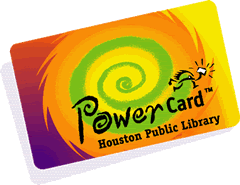
How has your library system campaigned to increase library card registration and use among teens? In past years we did a campaign called Powercard that won the John Cotton Dana Award from ALA for a PR campaign and the Texas Library Association Library Project of the Year award. TV ads, billboards, newspaper advertising, outreaches at every event imaginable put a Powercard (the HPL library card pictured above) in the hands of about 3 million children and teens in the City of Houston and the surrounding area. We are currently not doing a promotion due to staffing shortages.
Should schools encourage students to register for library cards? If so, what do you recommend educational leaders/admin in schools do to encourage students to do so? What might the public library provide that schools do not or cannot provide? Schools should and do encourage students to get library cards. Some of our local private schools require one. Some schools give extra credit for having one. Many allow us to come to parents' night or to speak to students. We will also do entire classes at one time for teachers. We provide access to a wide range of resources that schools cannot afford. The library card gives access to our online resources from school. It also gives access to our extensive print collections which number about 3.7 million items that no school could afford or house.
What are some ways you envision schools working with your library system to put the library card to good use? Library cards are used at school to access our databases which are much more extensive than schools can provide. We do trainings for teachers and offer Continuing Education Credits for doing so. We also offer trainings for students at the library during school visits and at schools if requested. Teachers use their cards to check out materials for the classroom that the school cannot provide. Teens use their library cards to access virtual environments that provide training in information use, sharing, and sorting. Teens also can access a wide range of materials selected with them in mind. Our collections for teens have seen circulation growth every year for the last 5 or 6 years.
Is there anything else you'd like to add to the discussion of teens, libraries, library cards, etc.? Teens who enter the library and get cards find a far different environment than existed at our libraries even 5 years ago. We are striving to become even more relevant to them every day. Library cards provide access to the technology and resources that all teens need to learn to use and understand to be successful in the future.
Thank you, Sandy, for taking the time to share this information with us.
As you can see, one of the most powerful tools you can put in the hands of a high school student today may be a library card. Being the nerd that I am, I registered for my own Powercard the first week here in town. I have used the online research databases extensively already, checked out scores of books, downloaded audio and e-text format books, and more. Coupled with the bundle of resources I have available through school, the sky is the limit for what I can find to read and study and research. Why wouldn't we want the same thing for our students? (As if that weren't enough, museums here in Houston offer discounted or free admission for students with the Powercard!) Did I mention that the library card (sleek, slim, powerful) is FREE? Encourage your students to add a library card to their pile of educational tools (laptop, calculator, cell phone, old-fashioned books and notebooks) and see what a difference the library card can make.
*OK, if you live in small-town America and not in a major urban center, I can hear you grumbling now about lack of resources compared to Houston. Check out (no pun intended) your own library system before you send me hate email out of jealousy. You might be pleasantly surprised at the quality of the library system in your hometown. One of the most pleasant surprises related to living in Louisiana was the quality of their library system!
I know of no school in the nation whose librarians, tech team and media specialists believe their school has at their disposal every book, every database, every subscription they need to offer their students. Here in Houston, at least, a number of schools have partnered with the Houston Public Library System to help bridge that gap for their students. At my school, as well as at other schools throughout the city, high school students are required to register for one of the most powerful weapons available in education today - a library card.

The idea struck me as a good, if not great, idea but I decided to dig deeper. I went straight to the source and found Sandy Farmer at the Houston Public Library. Sandy graciously offered to answer a few questions for me, all of which are provided for your information below. I urge you to take the time to read the entire interview. I dare say you may be surprised at what you find. Then, stick around after the interview for a brief conclusion and challenge.
Please note that I'll use the term "library card" below to mean not only the card but also all the tools and resources to which it provides access. Also, the library referred to below is the amazing Houston Public Library.
(ME)What are the obvious advantages of a teen (MS or HS student) owning a library card from a public library? (Sandy) Checking out books, magazines, graphic novels, CD's, DVD's, etc. Access to our entire database collection including periodicals, streaming video, reference sources, medical information, etc.
What are the not-so-obvious advantages of a teen (MS or HS student) owning a library card from a public library? Use of our video gaming equipment. Central has 3 Wii's and 6 Playstation 3 consoles, along with 25 Nintendo DSi's and an extensive game collection that teens can use with a library card. The check out of game and controller insures that the equipment stays at the library. Three of our branches also have equipment available and we are about to push out DSi's to an additional 10 branches. The card, with birthdate on it, insures access to Teen our area for teens ages 13 to 18. Other ID is required if you do not have a library card.
How has your library system campaigned to increase library card registration and use among teens? In past years we did a campaign called Powercard that won the John Cotton Dana Award from ALA for a PR campaign and the Texas Library Association Library Project of the Year award. TV ads, billboards, newspaper advertising, outreaches at every event imaginable put a Powercard (the HPL library card pictured above) in the hands of about 3 million children and teens in the City of Houston and the surrounding area. We are currently not doing a promotion due to staffing shortages.
Should schools encourage students to register for library cards? If so, what do you recommend educational leaders/admin in schools do to encourage students to do so? What might the public library provide that schools do not or cannot provide? Schools should and do encourage students to get library cards. Some of our local private schools require one. Some schools give extra credit for having one. Many allow us to come to parents' night or to speak to students. We will also do entire classes at one time for teachers. We provide access to a wide range of resources that schools cannot afford. The library card gives access to our online resources from school. It also gives access to our extensive print collections which number about 3.7 million items that no school could afford or house.
What are some ways you envision schools working with your library system to put the library card to good use? Library cards are used at school to access our databases which are much more extensive than schools can provide. We do trainings for teachers and offer Continuing Education Credits for doing so. We also offer trainings for students at the library during school visits and at schools if requested. Teachers use their cards to check out materials for the classroom that the school cannot provide. Teens use their library cards to access virtual environments that provide training in information use, sharing, and sorting. Teens also can access a wide range of materials selected with them in mind. Our collections for teens have seen circulation growth every year for the last 5 or 6 years.
Is there anything else you'd like to add to the discussion of teens, libraries, library cards, etc.? Teens who enter the library and get cards find a far different environment than existed at our libraries even 5 years ago. We are striving to become even more relevant to them every day. Library cards provide access to the technology and resources that all teens need to learn to use and understand to be successful in the future.
Thank you, Sandy, for taking the time to share this information with us.
As you can see, one of the most powerful tools you can put in the hands of a high school student today may be a library card. Being the nerd that I am, I registered for my own Powercard the first week here in town. I have used the online research databases extensively already, checked out scores of books, downloaded audio and e-text format books, and more. Coupled with the bundle of resources I have available through school, the sky is the limit for what I can find to read and study and research. Why wouldn't we want the same thing for our students? (As if that weren't enough, museums here in Houston offer discounted or free admission for students with the Powercard!) Did I mention that the library card (sleek, slim, powerful) is FREE? Encourage your students to add a library card to their pile of educational tools (laptop, calculator, cell phone, old-fashioned books and notebooks) and see what a difference the library card can make.
*OK, if you live in small-town America and not in a major urban center, I can hear you grumbling now about lack of resources compared to Houston. Check out (no pun intended) your own library system before you send me hate email out of jealousy. You might be pleasantly surprised at the quality of the library system in your hometown. One of the most pleasant surprises related to living in Louisiana was the quality of their library system!
Friday, July 30, 2010
Administrators as Technology Leaders: Is Being Tech-Savvy Enough?
I'd like to address the following question posed by Scott McLeod at http://dangerouslyirrelevant.org/. The question is: Do administrators have to be technology-savvy themselves in order to be effective technology leaders in their organizations?
I'd like to begin by looking at a few lines from Building Engaged Schools by Gary Gordon. Gordon says of principals: To be sure, every principal must possess a great deal of knowledge and many skills these days, perhaps more of each than ever before... These talents, combined with knowledge and skills, create strengths that lead to outstanding performance.... Nevertheless, great principals intuitively distinguish between those aspects of running the school that play to their strengths and those that are better left to others. They delegate the latter tasks and activities whenever possible, refining over time their own sense of self-awareness and surrounding themselves with staff members who possess complementary talents. (p. 178)
Now, in light of Gordon's comments, let's revisit the original question. First, the more tech-savvy an administrator is in 2010, the farther he or she will be able to lead the school. Attitude often reflects leadership and a school community's attitude about technology can be influenced greatly by the principal. A principal's interest in technology, understanding of technology (hardware, software, web 2.0, etc.), and vision for integration of technology into classrooms will impact the school.
Having said that, perhaps as great an impact can be made by a principal who is wise enough to know his or her own limits, to know what he or she does not know. A principal may have the interest, vision and some understanding, but a principal cannot be expected to be an expert (possessing knowledge beyond the savvy level) in everything (try as we might). It is at this point, at the limits of a principal's knowledge, where the principal must be mature enough to surround himself or herself with others who possess more knowledge. This is where true experts in the field (technology coordinators, etc.) play a vital role in the success of the school.
A principal must understand where his or limits are and must solicit the counsel and employ the skills of those who are more tech-savvy. This is the point at which a principal's vision and understanding may in importance outweigh his or her knowledge, as it is the principal's duty to communicate a vision which the technology person/coordinator/department can bring to fruition. While it is important for an administrator to be savvy, it may be less important to be an expert than to know when to bring in the expert and empower him or her to carry out the principal's vision.
I'd like to begin by looking at a few lines from Building Engaged Schools by Gary Gordon. Gordon says of principals: To be sure, every principal must possess a great deal of knowledge and many skills these days, perhaps more of each than ever before... These talents, combined with knowledge and skills, create strengths that lead to outstanding performance.... Nevertheless, great principals intuitively distinguish between those aspects of running the school that play to their strengths and those that are better left to others. They delegate the latter tasks and activities whenever possible, refining over time their own sense of self-awareness and surrounding themselves with staff members who possess complementary talents. (p. 178)
Now, in light of Gordon's comments, let's revisit the original question. First, the more tech-savvy an administrator is in 2010, the farther he or she will be able to lead the school. Attitude often reflects leadership and a school community's attitude about technology can be influenced greatly by the principal. A principal's interest in technology, understanding of technology (hardware, software, web 2.0, etc.), and vision for integration of technology into classrooms will impact the school.
Having said that, perhaps as great an impact can be made by a principal who is wise enough to know his or her own limits, to know what he or she does not know. A principal may have the interest, vision and some understanding, but a principal cannot be expected to be an expert (possessing knowledge beyond the savvy level) in everything (try as we might). It is at this point, at the limits of a principal's knowledge, where the principal must be mature enough to surround himself or herself with others who possess more knowledge. This is where true experts in the field (technology coordinators, etc.) play a vital role in the success of the school.
A principal must understand where his or limits are and must solicit the counsel and employ the skills of those who are more tech-savvy. This is the point at which a principal's vision and understanding may in importance outweigh his or her knowledge, as it is the principal's duty to communicate a vision which the technology person/coordinator/department can bring to fruition. While it is important for an administrator to be savvy, it may be less important to be an expert than to know when to bring in the expert and empower him or her to carry out the principal's vision.
Saturday, July 17, 2010
Always on the Lookout for Items of Interest for My Teachers
Those who have worked for me in the past will attest to the fact that I love to pass along reading assignments. Sometimes the readings are in the form of books, sometimes articles, sometimes blurbs on websites. I always have my eye open for something of interest and/or value I can pass along to my teachers, either for their own use or for use in the classrooms. This doesn't take much time or effort on my part and it can be pretty valuable. Let me explain how this works using an example from this morning.
I have about a dozen different news apps on my iPhone that I browse every day. Some are tech-related (Engadget, for example), some science-related (Popular Science, for example), some history-related, and some are just news. I scan the headlines in search of nuggets of interest for my teachers. When I find something that can be used by teachers in multiple disciplines, I consider this a gold nugget, a four-leaf clover, if you will.
This morning I came across a fascinating article called Alexander the Great Killed by Toxic Bacteria? from Discovery News (via my Discovery News app). My first thought was, "My history teacher needs this." As I read, I discovered fascinating biology and literature/mythology included in the article, too. Using my iPhone, I immediately forwarded the article to my World History teacher, my Biology teacher and my English teacher with a brief note that read, "Could be an interesting interdisciplinary lesson. I also sent this to..."
These nuggets are out there if you look for them. I believe small things make a big difference in the classroom; it is our job as educational leaders to seek out and share such nuggets with our teachers to help them make a big difference in the lives of our students.
I have about a dozen different news apps on my iPhone that I browse every day. Some are tech-related (Engadget, for example), some science-related (Popular Science, for example), some history-related, and some are just news. I scan the headlines in search of nuggets of interest for my teachers. When I find something that can be used by teachers in multiple disciplines, I consider this a gold nugget, a four-leaf clover, if you will.
This morning I came across a fascinating article called Alexander the Great Killed by Toxic Bacteria? from Discovery News (via my Discovery News app). My first thought was, "My history teacher needs this." As I read, I discovered fascinating biology and literature/mythology included in the article, too. Using my iPhone, I immediately forwarded the article to my World History teacher, my Biology teacher and my English teacher with a brief note that read, "Could be an interesting interdisciplinary lesson. I also sent this to..."
These nuggets are out there if you look for them. I believe small things make a big difference in the classroom; it is our job as educational leaders to seek out and share such nuggets with our teachers to help them make a big difference in the lives of our students.
Friday, January 29, 2010
The Most Frightening Part of Increased Plugged-In Time
So, why should we as educators be frightened that our kids are now spending more and more hours online or plugged-in to social media? Obviously the more our kids stay plugged in then the less they're reading, sleeping, working on schoolwork or spending time with family. However, there is a much more frightening aspect of digital natives increasing their already astonishing number of hours plugged in to social media. I'll explain.
I met last week with two Department of Justice agents who specialize in cybercrimes. We spent about almost two hours discussing potential online threats and dangers our kids face every day. I sat stunned as they gave me statistic after statistic about how many children and teens have had conversations online with complete strangers, how many of those strangers have lied about how old they actually are, how many of those strangers have told the truth about how old they are but the kids don't care, and (the most frightening of all) how many children and teens have received the invitation LMIRL (let's meet in real life). As an educator whose entire career has been in the digital age, I have seen and dealt with all sorts of things. I am neither naive nor easily shocked. However, after our conversation I felt overwhelmed.
The good news for educators and parents is that there are measures we can take to protect our kids. The greatest weapon against the evils that lurk in the chat rooms and social networking sites is education. We will be doing an educational series soon not only about the threats I've mentioned here but also about other digital dangers including sexting, cyberstalking and more. We're going to host the Department of Justice agents for an assembly one morning in school to educate the students and then for an assembly of a much more graphic nature at night to show the stark reality to our parents. This assembly will be sandwiched between Advisory sessions about sexting, compulsive texting, cyberbullying, cyberstalking and more. There are a number of great resources available but the newest one I've come across is A Thin Line. We'll probably use much of their information in our Advisory sessions while the DOJ will use its own material.
I encourage you to contact the FBI or Department of Justice, speak to someone who works with cybercrimes, and invite them to your office to get you caught up on how predators are hunting our kids. You will be shocked. I guarantee it.
I met last week with two Department of Justice agents who specialize in cybercrimes. We spent about almost two hours discussing potential online threats and dangers our kids face every day. I sat stunned as they gave me statistic after statistic about how many children and teens have had conversations online with complete strangers, how many of those strangers have lied about how old they actually are, how many of those strangers have told the truth about how old they are but the kids don't care, and (the most frightening of all) how many children and teens have received the invitation LMIRL (let's meet in real life). As an educator whose entire career has been in the digital age, I have seen and dealt with all sorts of things. I am neither naive nor easily shocked. However, after our conversation I felt overwhelmed.
The good news for educators and parents is that there are measures we can take to protect our kids. The greatest weapon against the evils that lurk in the chat rooms and social networking sites is education. We will be doing an educational series soon not only about the threats I've mentioned here but also about other digital dangers including sexting, cyberstalking and more. We're going to host the Department of Justice agents for an assembly one morning in school to educate the students and then for an assembly of a much more graphic nature at night to show the stark reality to our parents. This assembly will be sandwiched between Advisory sessions about sexting, compulsive texting, cyberbullying, cyberstalking and more. There are a number of great resources available but the newest one I've come across is A Thin Line. We'll probably use much of their information in our Advisory sessions while the DOJ will use its own material.
I encourage you to contact the FBI or Department of Justice, speak to someone who works with cybercrimes, and invite them to your office to get you caught up on how predators are hunting our kids. You will be shocked. I guarantee it.
Sunday, January 24, 2010
Digital Natives Increase Plugged-In Time
A recent New York Times article reveals startling new information about our digital native kids. Just when we thought our digital natives couldn't log any additional on-line or plugged-in time, they do just that. According to the article, If Your Kids Are Awake, They’re Probably Online, by Tamar Lewin, the Kaiser Family Foundation repeated a study last done five years ago and discovered that digital natives are now online or plugged-in "seven and a half hours a day... compared with less than six and a half hours five years ago." While that is startling enough, because digital natives multi-task so well, these kids pack about eleven hours of media use into these seven and a half hours each day. Of the seven and a half hours, digital natives average about two hours of that time on a mobile device. The study shows that more than 70% of teens have a TV in their rooms and more than 33% of teens have a computer with internet access in their rooms. The new study further supports the idea that our schools and our classrooms must continue to make strides in an effort to keep kids literally plugged in to education. More integration of technology into daily classroom activities, allowing students more access to technology for academic endeavors, and more out-of-the-box thinking and planning by teachers are just a few of the things that must happen in schools to keep our kids focused on their education.
All of these statistics are fascinating but on some level they should be downright frightening. Why? I'll explain in my next post and the explanation has nothing to do with classroom education.
All of these statistics are fascinating but on some level they should be downright frightening. Why? I'll explain in my next post and the explanation has nothing to do with classroom education.
Subscribe to:
Posts (Atom)